
Playing Chinese Checkers Might be akin to Russian Roulette

This year marks the 250th anniversary of the birth of the United States as a nation. Having lived under the democratic and electoral systems of both Canada and the United States, I have become captivated by the remarkable intellect of the American Founders and Framers. This admiration was born from their deep abhorrence of British rule and the injustice of taxation without representation.
While Canada’s egalitarian parliamentary system is largely a continuation of the one used by the United Kingdom for centuries, the founders of the United States envisioned a different path — one emphasizing greater democratic scope and individual liberty.
On a local level, Canadians would not recognize the practice of electing officials such as sheriffs, clerks, judges, and coroners. Even at the highest level, the president is directly elected by the people (through the Electoral College). In Canada, by contrast, the prime minister is not directly elected; they are typically the leader of the party that wins the most seats in Parliament and are formally appointed by the governor general. The governor general is not elected; the position is appointed by the British monarch on the advice of the Prime Minister of Canada.
In the United States, the legislative branch consists of the House of Representatives and the Senate, which have equal power to propose and pass laws. Both chambers must agree on a bill before it is sent to the president for final approval. Members of both the House and Senate are elected by the general population. The number of Representatives is based on each state’s population and is apportioned into congressional districts, while the Senate consists of two elected senators from each state, regardless of population.
In Canada, Members of Parliament are elected by citizens in specific ridings (electoral districts). Senators, however, are appointed by the Governor General on the advice of the Prime Minister. Senators may serve until the age of 75 unless they resign earlier. They rarely challenge legislation proposed by the House of Commons and are generally viewed as a rubber-stamp assembly. My utmost grievance with Canadian politics, at both the federal and provincial levels, is the ability to create a coalition government where one party joins with another to manufacture a majority. This may occur when no single party wins a clear majority in an election. This amalgamation has happened on numerous occasions, and I suggest it is not what the populace voted for – thus true representation is obscured.
While neither political process or structure is perfect or infallible, both are ultimately superior to communist, autocratic, or theocratic rule - as is free market enterprise. Yet progressive politicians in both countries are in search of a more restrictive and prohibitory system — although theses politicians, at times, try to conceal the deficiencies of these non-democratic structures.
In my article “Whose Side Are You On,” I discuss the many immoral and appalling issues regarding life, livelihoods, and liberties in Communist China.
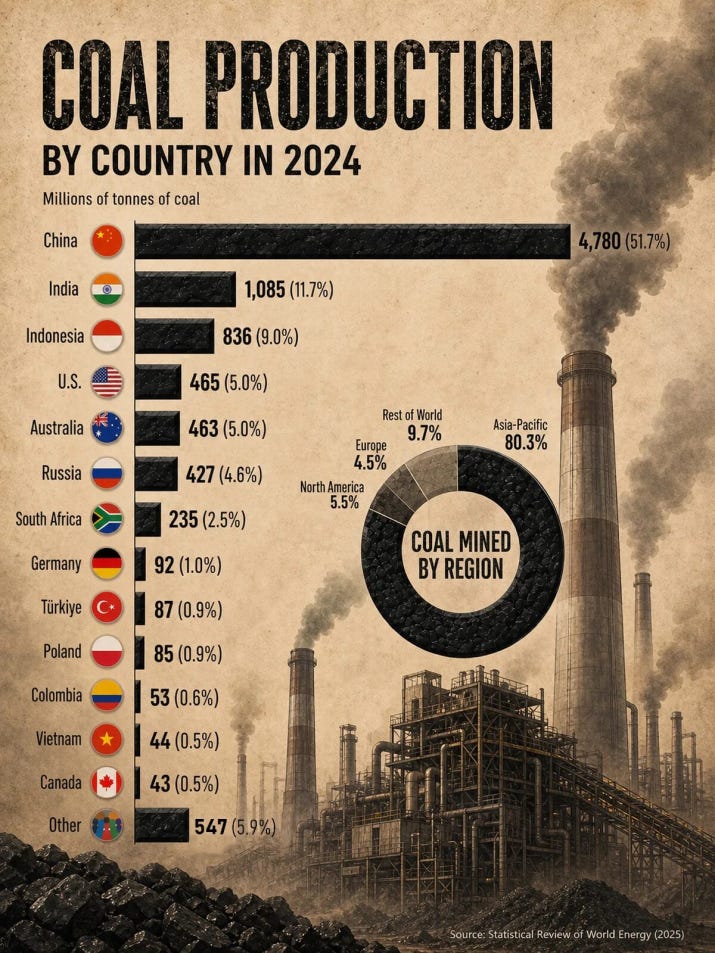
As far as CO₂ emissions are concerned, as shown in the photo at the bottom, China burns more coal than the rest of the world combined. Nonetheless, progressive politicians and greens around the world are turning to China for assistance in their continued battle to fabricate the narrative of climate change and make it appear a significant reality. The United Nations has repeatedly called on China to assume a leadership role in global climate action, particularly as traditional leaders like the US face political shifts or retreat from previous commitments. The USA has terminated its membership in the Paris Climate Accord.
European Union officials, including Climate Commissioner Wopke Hoekstra, have urged China to assume greater leadership in global climate action.
While the burning of coal can be made environmentally cleaner and particulate matter can be reduced through the use of wet scrubbers and efficiency improvements, carbon capture is primarily meaningful only to climate change campaigners. China is well known for its issues with burning dirty coal, as evidenced by the severe smog problems that plague the country daily. The air in China’s major cities is so contaminated that, when the wind is stagnant, it becomes difficult to see.
As I write in “The Blind Utopian Environmentalist“, “China’s Yangtze River, Eurasia’s longest at 3,915 miles, and the third-longest waterway in the world, is also known as the world’s most polluted river. The river’s major pollutants include industrial and human sewage, ship waste, agricultural pesticides, and sediment accumulation”.
Despite China being the filthiest, most corrupt nation on earth, perhaps equaled only by Russia, they are who the progressive politicians, environmental bureaucrats and the green alarmist crowd want as their accomplices. Some are so hyped on the false message surrounding the existential threat of climate change, they rationalize authoritarianism.
While some of my narrative in this article, may seem somewhat disrespectful to Canada’s political system, to my Canadian readers, be it known, while it is lined with 13 stripes, my heart is still shaped like a red maple leaf.
I'm very Happy in Canada, and would never consider living in a Country with that Moron as the Head of the supposed Greatest Country in the world, which it ONCE was. Sad to see! I'm hoping for better times in the future. Have a good May Run Ron!